Unlock your smile's potential with Dental Implants in Centerville, MN
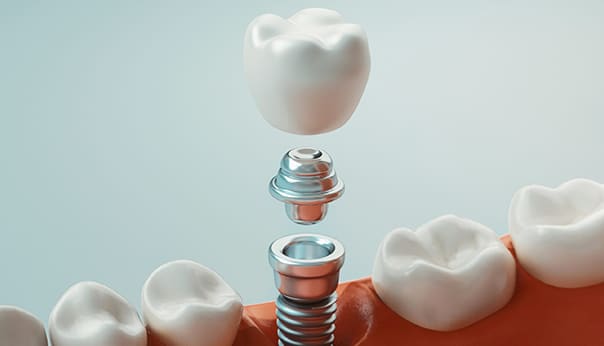
Dental implants are tiny surgical posts that seamlessly integrate with the body and function just like natural tooth roots. Once they are implanted and fused with the adjacent bone, dental implants offer unmatched stability for individual crowns, bridges, and dentures. Being the most cutting-edge approach to replacing missing teeth, they provide gratifying, durable, and functional solutions for attaining a flawless smile.
Consider all the benefits
Reclaiming a full and aesthetically pleasing smile is achievable with dental implants, whether you're missing one tooth, several, or even all. The prevalence of dental implants is on the rise, with around 3 million individuals having already undergone the procedure, and this number is expanding by 500,000 annually. The increasing popularity of dental implants can be attributed to the multitude of advantages they provide in comparison to alternative treatment methods.
While traditional fixed bridges and dentures are effective solutions for replacing missing teeth, dental implants have several advantages:
- Dental implants closely replicate the look, feel, and function of natural teeth.
- With proper placement, oral hygiene, and regular care, dental implants can last for many years.
- Dental implants stimulate the underlying bone, preventing bone loss and preserving natural facial contours.
- Unlike removable dentures, implants behave like natural teeth and do not slip or dislodge while speaking or eating.
- Dental implants allow for easy speaking, eating, and tasting all types of food without restrictions.
- Dental implants do not decay and are not susceptible to cavities.
- Unlike fixed bridges, dental implants do not require any preparation or crowning of adjacent teeth.
Choose dental implants for a natural-looking and long-lasting solution to missing teeth.
Types of Dental Implants
Single-tooth implant
In the conventional fixed bridge procedure, teeth on both sides of the vacant space are typically prepared and crowned. These crowned teeth serve as a foundation for the artificial teeth, or "pontics," that span the gap. Much like a bridge spanning water relies on sturdy pillars at each end for support, a dental bridge derives its strength and stability from the crowned teeth fused to one or more pontics.
On the other hand, a cantilever fixed bridge, though akin to the traditional fixed bridge, diverges in a crucial way. In this case, only one side of the pontic is attached to a crown for support.
Implant-supported fixed bridges
An implant-supported bridge is an effective solution for replacing multiple missing teeth. It not only preserves the health of neighboring natural teeth but also prevents bone shrinkage and maintains facial contours by providing necessary bone stimulation. Unlike a traditional fixed bridge, this type of bridge does not involve the preparation and crowning of adjacent natural teeth. Instead, it relies on strategically placed dental implants to support all the necessary crowns and replacement teeth.Full arch replacement with four or six Implants
A complete set of replacement teeth supported by implants is a great alternative to full dentures. This solution not only restores a natural-looking smile but also provides the same functionality and sensation as real teeth. Unlike traditional dentures, these replacement teeth are fixed in place and cannot be removed. This eliminates the need for messy adhesives and the hassle of cleaning and sanitizing dentures. With this solution, individuals can speak, smile, and chew with confidence. Additionally, temporary teeth can be immediately placed, with a permanent set following once the implants have fully integrated with the surrounding bone.Implant-retained denture
An implant-supported denture, also known as this type of denture, is connected to strategically placed implants in the upper or lower jaw. These implants serve as reliable anchors, ensuring stability and retention for the denture. This increased level of support allows individuals to smile, speak, and eat with confidence and ease.Are dental implants right for me?
If you are uncertain about whether you qualify for dental implants, it is a straightforward process to determine your eligibility. At Lakeview Family Dentistry, we not only evaluate your smile but also offer thorough responses to your questions and discuss the most appropriate dental implant choices for you. Our approach involves treating each smile as unique, developing customized treatment plans based on your medical and dental history, current oral health, desired cosmetic results, lifestyle, and financial factors.
How are dental implants placed?
Thorough planning and meticulous execution are paramount in every phase of dental care, spanning from the initial treatment strategy to the precise installation of dental implants, as well as the design and insertion of final crowns, bridges, or dentures.
Typically conducted as a minor outpatient procedure, dental implant surgery's complexity hinges on factors such as the type and quantity of implants and any necessary preparations for the underlying bone.
In our approach to patient care, effective communication takes precedence. Before your dental implant procedure, we engage in discussions about dental anesthesia, sedation options, and furnish comprehensive pre- and post-operative care instructions. Throughout the entire process, our office ensures that you remain well-informed.
Following the placement of a dental implant, a few months are typically required for full integration with the surrounding bone. Some implant solutions allow for the immediate placement of a temporary crown or bridge, while others mandate patience for complete healing and fusion with the adjacent bone before the permanent prostheses are affixed.
Training Information About
Dr. Carrells
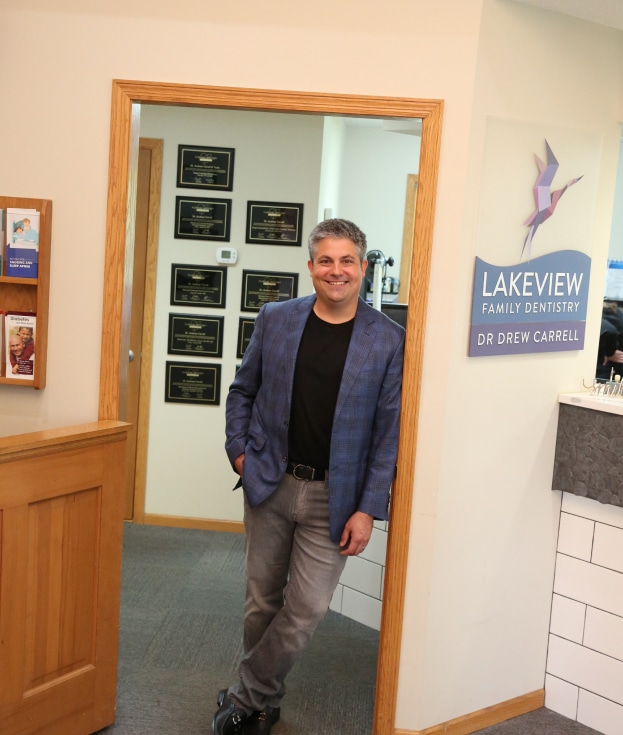
At Lakeview Family Dentistry, we take pride in providing the most advanced and innovative dental implant procedures. Choosing us for your dental implant needs means you're not just getting treatment – you're receiving top-tier care from Dr. Carrell, a dentist dedicated to staying at the forefront of dentistry through continuous education and training.
Dr. Carrell's commitment to lifelong learning led him to complete the prestigious 9-Day Regenerator Program at the Urban Regeneration Institute in Budapest. This rigorous program, held over three sessions, represents the highest level of education in dental implant and "all on x" techniques. It offers the most comprehensive curriculum available, designed to equip clinicians with the expertise to manage even the most complex cases involving advanced hard and soft tissue defects.
Through this program, Dr. Carrell ensures he remains both academically and clinically proficient, providing exceptional care to every patient. Additionally, the program fosters strong connections with leaders in dental implant techniques and technology, enabling ongoing consultation and collaboration. This means that when you choose Lakeview Family Dentistry for your dental implant procedure, you benefit not only from Dr. Carrell's expertise but also from his access to cutting-edge knowledge and resources. With Dr. Carrell at the helm, you can be confident that you're receiving the most advanced and comprehensive dental implant treatment available. Your smile deserves nothing less.