

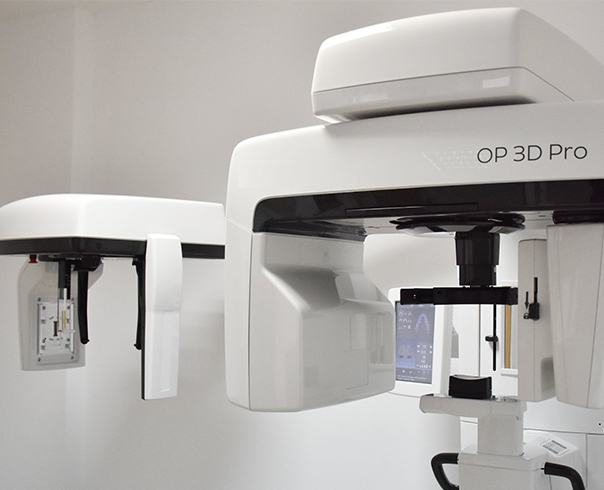
3D CT CONE BEAM
3D dental imaging, also referred to as Cone Beam Computed Tomography (CBCT), enables us to visualize a greater extent of anatomy with enhanced clarity compared to conventional film-based dental x-rays.
What Is 3d Ct Imaging?
Traditional x-rays use radiation waves to capture 2D images of small body areas, including specific sections of the smile for dentists. On the other hand, 3D computed tomography (CT) scans provide clearer images of oral and facial structures, allowing us to understand their overall function. Unlike flat images of a tooth, CT scans enable us to rotate a 3D image of a damaged tooth, examining every facet. This capability extends beyond individual teeth, as CT scans allow us to visualize every aspect of the full smile.
Why is 3D CT Imaging Used?
We may suggest utilizing 3D CT scans to enhance dental care for patients in various situations, such as:
- Assessing and planning treatment for individuals with temporomandibular joint (TMJ) dysfunction
- Creating surgical guides for dental implant placement and attaching replacement teeth
- Preparing for oral surgery procedures like tooth extractions
- Ensuring the safety and effectiveness of root canal therapy.
What are the benefits of 3D CT scanning in dental care?
In our office, 3D CT scans are utilized to enhance the patient experience in various ways. These include allowing patients to view 3D images of their smile on chairside computer monitors, enabling them to better understand areas of concern and potential treatment options. Additionally, we have the ability to highlight or zoom in on specific areas, providing patients with a clearer perspective on their oral health issues. The digital files can be instantly shared with dental labs, insurance providers, and specialists, expediting the treatment process. Furthermore, these digital files can be easily stored, reassessed, and compared with other x-rays, ultimately improving the effectiveness and success rate of dental treatments.